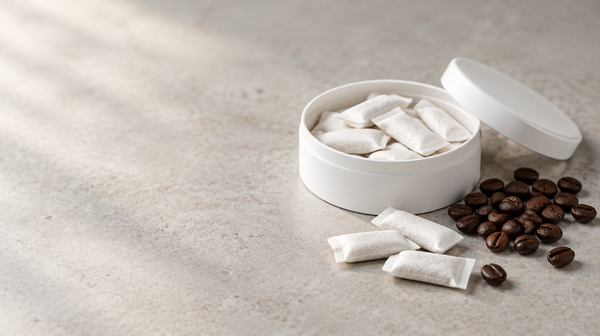









Snus is not a safe option during pregnancy, and neither are nicotine pouches. The reason is the nicotine itself: it crosses the placenta, narrows blood vessels and affects how the unborn child's brain and lungs develop. Swedish registry studies with more than a million births show that women who used snus in pregnancy had a higher risk of stillbirth, preterm birth, oral clefts and breathing pauses in their newborns. This article sums up what those studies found, what happens when women stop early, and what that means for nicotine pouches.
Key facts
- A 2023 systematic review of 18 cohort studies links snus in pregnancy to a higher risk of neonatal apnea (about twice the odds), stillbirth, preterm birth, low birth weight and oral clefts.[1]
- In the Swedish Medical Birth Register, snus users had 1.6 times the odds of stillbirth compared with women who used no tobacco, about the same as light smokers.[2]
- Women who stopped snus before their first antenatal visit showed no increased risk of oral clefts in their infants.[3]
- Nicotine pouches have not been studied in pregnancy. They contain the same nicotine, so the German Federal Institute for Risk Assessment (BfR) advises pregnant and breastfeeding women against them.[4]
Why nicotine matters in pregnancy
Snus and nicotine pouches are often described as the cleaner choice because nothing is burned. For the lungs of the user that is true. For an unborn child it changes little, because the substance that reaches the baby is nicotine, and nicotine arrives whether it comes from smoke or from a pouch under the lip.
Nicotine passes the placenta and reaches the child in concentrations similar to those in the mother's blood. It narrows the blood vessels in the placenta, which reduces the supply of oxygen and nutrients, and it acts on nicotine receptors in the developing brain and in the centres that control breathing. That is the biological background for the outcomes the Swedish studies measured: lower birth weight, earlier births and breathing pauses after birth.[1]
How nicotine works in an adult body is covered in our article on snus effects. In pregnancy the point is simpler: there is no known safe dose of nicotine for the unborn child.
What the Swedish studies show
Sweden is the only country where enough women used snus during pregnancy for researchers to measure the effects on a large scale. The Swedish Medical Birth Register records tobacco use at the first antenatal visit for almost every pregnancy, which makes it possible to compare snus users, smokers and women who used no tobacco at all.
In 2023 a Norwegian research group pooled the available evidence in a systematic review for the journal Addiction. It covered 18 cohort studies with up to a million participants. The table shows the adjusted odds ratios they reported: a value of 1.5 means that the odds of that outcome were 50 percent higher among snus users than among women who used no tobacco.[1]
| Outcome | Adjusted odds ratio (95 % CI) | Confidence in the estimate |
|---|---|---|
| Neonatal apnea (breathing pauses in the newborn) | 1.96 (1.30 to 2.96) | moderate |
| Stillbirth | 1.43 (1.02 to 1.99) | low |
| Extremely preterm birth | 1.69 (1.17 to 2.45) | low |
| Moderately preterm birth | 1.26 (1.15 to 1.38) | low |
| Small for gestational age | 1.26 (1.09 to 1.46) | low |
| Oral cleft malformations | 1.48 (1.00 to 2.21) | low |
| Birth weight | 72 g lower on average | low |
| Preeclampsia, antenatal bleeding | 1.11 and 1.15, intervals include 1 | uncertain |
The single most cited study is older. In 2010 Wikström and colleagues compared 7,629 snus users with 504,531 women who used no tobacco. Snus users had 1.6 times the odds of stillbirth (95 % CI 1.1 to 2.3), and 2.1 times the odds of a preterm stillbirth. Light smokers had an odds ratio of 1.4 and heavy smokers 2.4. The authors wrote that Swedish snus does not appear to be a safe alternative to cigarette smoking during pregnancy.[2]
Two details from that study matter for how the risk is read. First, the snus-related stillbirth risk stayed the same after the researchers excluded cases linked to preeclampsia, bleeding or growth restriction, so the mechanism seems to differ from smoking. Second, the absolute numbers are small: 5.2 stillbirths per 1,000 pregnancies among snus users compared with 2.7 per 1,000 among non-users. The risk is roughly doubled, but most pregnancies with snus exposure still end well, which is why the registry size matters for detecting the effect at all.
Stopping early makes a measurable difference
The clearest practical finding comes from a 2014 study on oral clefts that looked at timing. Among 975,866 infants, mothers who continued to use snus into early pregnancy had an adjusted odds ratio of 1.48 for any oral cleft in their child. Mothers who stopped snus before their first antenatal visit, usually around week 8 to 12, had an odds ratio of 0.71, which means no increased risk at all. More than half of the women who used snus in the three months before pregnancy had already stopped by that visit.[3]
The same pattern appears for preterm birth: in a Swedish cohort from 1999 to 2012, the excess risk of extremely preterm birth disappeared in women who stopped using tobacco between the first and second antenatal visit.[1] In plain terms, the damage is linked to ongoing exposure, and stopping in the first weeks removes most of the measurable risk.
Do nicotine pouches count the same?
There is no pregnancy study on tobacco-free nicotine pouches yet, because the products are too new and too few women have used them in pregnancy for registry research. What is known is the chemistry: pouches deliver nicotine through the lining of the mouth in the same way as snus, and the dose per pouch is often higher. The BfR found manufacturer declarations of up to 50 mg per pouch in products on the German market, against about 8 mg in a typical Swedish snus portion.[4]
For that reason the BfR, in its 2021 opinion on nicotine pouches, advises pregnant and breastfeeding women against using them, citing the effects of nicotine and its transfer into breast milk.[4] The Norwegian review authors reach the same conclusion from the snus data: since nicotine is the likely cause of the outcomes they measured, the findings apply to other oral nicotine products as well.[1]
If you want to compare the products themselves, our guide to nicotine pouches explains strengths and formats. None of that changes the answer for pregnancy.
Breastfeeding
Nicotine passes into breast milk and reaches the infant. The amount depends on the dose and the time between use and feeding. The BfR names the transfer into breast milk as the reason for advising breastfeeding women against nicotine pouches, and the same applies to snus.[4] If stopping at once is not realistic, a midwife can help with the timing of feeds, but the aim stays the same: no nicotine while breastfeeding.
What to do if you use snus and are pregnant
- Stop now rather than cutting down. The Swedish data show the benefit of stopping before the first antenatal visit. Every week without nicotine counts.
- Tell your midwife or doctor. Snus use is recorded at the first antenatal visit in Sweden for a reason: it changes how the pregnancy is monitored. Be honest about the amount and the strength.
- Do not switch to nicotine pouches. They are the same substance in a different package, often stronger.
- Nicotine replacement products only on medical advice. Patches or gum are sometimes used for heavy smokers who cannot stop otherwise. In pregnancy that is a decision for a doctor, not for the shelf.
- Keep the habit without the substance, if that helps. Pouches without nicotine contain no nicotine. They are not medical products, and their flavourings and sweeteners are not studied in pregnancy either, so show the ingredient list to your midwife before you use them.
- Plan for withdrawal. Irritability, poor sleep and cravings usually peak in the first week. Our tips for quitting snus and the article on snus addiction explain what to expect.
Snus versus cigarettes in pregnancy
Readers often ask whether snus is at least the lesser evil. For stillbirth, preterm birth and oral clefts the Swedish point estimates for snus and for smoking are of a similar size. Smoking does more harm to growth, with a larger drop in birth weight, while snus was linked to a higher risk of neonatal apnea than smoking.[1] Neither product has a safe level in pregnancy. The one message every study agrees on is that stopping tobacco and nicotine altogether, as early as possible, removes most of the measurable risk.
For the general health picture outside pregnancy, see our articles on snus side effects and snus and cancer.
Sources
- Brinchmann BC, Vist GE, Becher R, Grimsrud TK, Elvsaas IKØ, Underland V, Holme JA. Use of Swedish smokeless tobacco during pregnancy: a systematic review of pregnancy and early life health risk. Addiction, 2023. doi.org/10.1111/add.16114
- Wikström AK, Cnattingius S, Stephansson O. Maternal use of Swedish snuff (snus) and risk of stillbirth. Epidemiology, 2010. pubmed.ncbi.nlm.nih.gov
- Gunnerbeck A, Edstedt Bonamy AK, Wikström AK, Granath F, Wickström R, Cnattingius S. Maternal snuff use and smoking and the risk of oral cleft malformations: a population-based cohort study. PLoS ONE, 2014. pubmed.ncbi.nlm.nih.gov
- Bundesinstitut für Risikobewertung (BfR). Vorläufige gesundheitliche Bewertung von Nikotinbeuteln (Nikotinpouches). Stellungnahme Nr. 027/2021 vom 20. September 2021. www.bfr.bund.de
This article is general health information based on the studies listed above. It does not replace advice from your doctor or midwife.
Намерете подходящата торбичка
Сравнете сила, вкусове и марки в нашия магазин.
Само за пълнолетни над 18 години. Никотинът предизвиква зависимост. Продаваме продуктите, споменати в нашите ръководства. Редакционното ни съдържание се пише независимо.